
Issue 12 (June 16)
President Trump Executive Actions
Trump Administration Actions (all actions available here):
- Advancing Women’s Health to Improve Outcomes in All Phases of Life (10/19/26)
- Inaugurating the Era of Super Intelligence (9/29/26)
- Enhancing Program Integrity and Interagency Coordination in the Administration of the H-1B Nonimmigrant Visa Program (9/18/26)
- Restoring Trust in the Smithsonian Institution (7/24/26)
- Implementing Schedule Policy/Career in the Excepted Service (6/3/26) (MORE INFORMATION)
- Promoting Advanced Artificial Intelligence Innovation and Security (6/2/26)
- Addressing DEI Discrimination by Federal Contractors (3/26/26)
- Addressing Addiction through the Great American Recovery Initiative (1/29/26)
- Memorandum: Withdrawing the United States from International Organizations, Conventions, and Treaties that are Contrary to the Interests of the United States (1/7/26)
- Increasing Medical Marijuana and Cannabidiol Research (12/18/25)
- Ensuring a National Policy Framework for Artificial Intelligence (12/11/25) (MORE INFORMATION)
- President’s Management Agenda (12/8/25) (MORE INFORMATION)
- Launching the Genesis Mission (11/24/25) (MORE INFORMATION)
- Ensuring Continued Accountability in Federal Hiring (10/15/25)
- Fiscal Year (FY) 2027 Administration Research and Development Budget Priorities and Cross-Cutting Actions (9/23/25) (MORE INFORMATION)
- Restriction on Entry of Certain Nonimmigrant Workers (9/19/25)
- Memorandum: Use of Appropriated Funds for Illegal Lobbying and Partisan Political Activity by Federal Grantees (8/28/25)
- Improving Oversight of Federal Grantmaking (MORE INFORMATION) (8/7/25)
- Ensuring Transparency in Higher Education Admissions (MORE INFORMATION) (8/7/25)
- Preventing Woke AI in the Federal Government (MORE INFORMATION) (7/23/25)
- Creating Schedule G in the Excepted Service (7/17/25) (MORE INFORMATION)
- Memorandum: Ensuring Accountability and Prioritizing Public Safety in Federal Hiring (7/7/25)
- Establishing the President’s Make America Beautiful Again Commission (7/3/25)
- Enhancing National Security by Addressing Risks at Harvard University (6/4/25)
- Restricting the Entry of Foreign Nationals to Protect the United States from Foreign Terrorists and Other National Security and Public Safety Threats (6/4/25)
- Restoring Gold Standard Science (5/23/25) (MORE INFORMATION)
- Increasing Efficiency at the Office of the Federal Register (5/9/25)
- Improving the Safety and Security of Biological Research (5/5/25)
- Improving the Safety and Security of Biological Research (5/5/25)
- Strengthening Probationary Periods in the Federal Service (4/24/25)
- White House Initiative to Promote Excellence and Innovation at Historically Black Colleges and Universities (4/23/25)
- Reforming Accreditation to Strengthen Higher Education (4/23/25)
- PROPOSED RULE: Improving Performance, Accountability, and the Civil Service (4/23/25)
- Transparency Regarding Foreign Influence at American Universities (4/23/25)
- Extension of Hiring Freeze (4/17/25)
- Restoring Truth and Sanity to American History (3/27/25) (MORE INFORMATION)
- Improving Education Outcomes by Empowering Parents, States, and Communities (3/20/25) (MORE INFORMATION)
- Continuing the Reduction of the Federal Bureaucracy (3/14/25) (MORE INFORMATION)
- Additional Rescissions of Harmful Executive Orders and Actions (3/14/25)
- Implementing the President’s DOGE Cost Efficiency Initiative (2/26/25) (MORE INFORMATION)
- Ensuring Lawful Governance and Implementing the President’s DOGE Deregulatory Initiative (2/19/25) (MORE INFORMATION)
- Radical Transparency about Wasteful Spending (2/18/25) (MORE INFORMATION)
- Establishing the President’s Make America Healthy Again Commission (2/13/25)
- Implementing the President’s “Department of Government Efficiency” Workforce Optimization Initiative (2/11/25) (MORE INFORMATION)
- Advancing United States Interests When Funding Nongovernmental Organizations (2/6/25) (MORE INFORMATION)
- Ending Radical Indoctrination in K-12 Schooling (1/29/25)
- President’s Council of Advisors on Science and Technology (1/23/25)
- Removing Barriers to American Leadership in Artificial Intelligence (1/23/25)
- Ending Illegal Discrimination and Restoring Merit-Based Opportunity (1/21/24) (MORE INFORMATION)
- Ending Radical and Wasteful Government DEI Programs and Preferencing (1/20/25)
- Defending Women from Gender Ideology Extremism and Restoring Biological Trust to the Federal Government (1/20/25)
- Establishing and Implementing the President’s “Department of Government Efficiency” (1/20/25)
- Restoring Accountability to Policy-Influencing Positions within the Federal Workforce (1/20/25) – Reinstates Trump Administration’s 2020 EO creating a new Schedule F in the Federal Excepted Service
- Withdrawing the U.S. from the WHO (1/20/25)
- Putting America First in International Environmental Agreements (1/20/25) – Withdraws the U.S. from the Paris Climate Accord, among other actions.
- Hiring Freeze (1/20/25) (MORE INFORMATION)
- Return to In-Person Work (1/20/25) (MORE INFORMATION)
- Restoring Freedom of Speech and Ending Federal Censorship (1/20/25)
- Initial Rescissions of Harmful Executive Orders and Actions (1/20/25) – Rescinds dozens of Biden Administration Executive Orders
Find COSSA’s full list of Trump’s Executive Actions and more information here or on the Social Science Space Tracker.
House Advances LHHS Bill, Senate Delays Markups
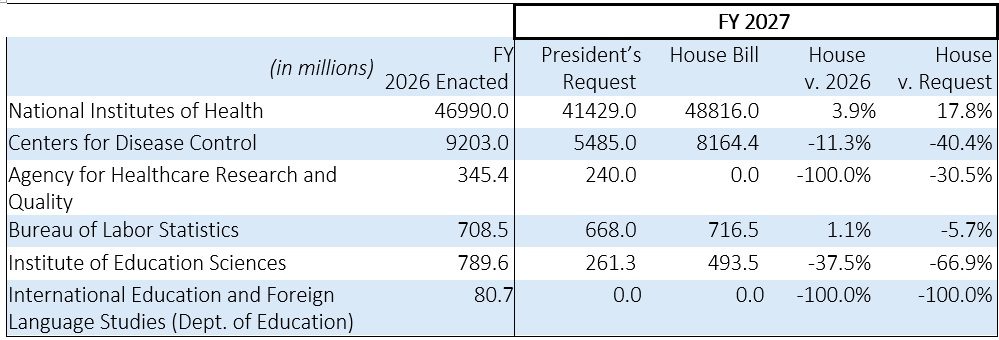
On June 5, the House Appropriations Committee released the Labor, Health and Human Services, Education, and Related Agencies (LHHS) appropriations bill for fiscal year (FY) 2027. The bill was advanced out of the committee in a 34 to 28 vote along party lines. Earlier this year, the President’s request called for sweeping cuts to the federal agencies that fund social and behavioral science research (see analysis). While the House bill still includes cuts to several agencies, the House has largely rejected the deep cuts proposed by the Trump Administration.
Notably, exceptions include several programs housed under the Department of Education, which have been a longtime target of the Administration. Under this bill, the Institute of Education Sciences (IES), which is the research arm of the Department of Education, would receive a staggering 37.5 percent cut, and several programs, including International Education and Foreign Language Studies, would be eliminated. The Agency for Healthcare Research and Quality (AHRQ) within the Department of Health and Human Services (HHS) would also be eliminated under the bill, as proposed in 2016, 2024, 2025, and 2026. Stay tuned for COSSA’s full analysis of the House LHHS appropriations bill.
On the other side of Capitol Hill, the Senate Appropriations Committee has delayed consideration of the Commerce, Justice, Science, and Related Agencies (CJS) bill, which was scheduled for June 4 (see previous coverage). With the rapidly approaching summer recesses, it’s unclear if the Senate will release any of their appropriations bills before leaving Washington.
Stay tuned for COSSA’s continued coverage of the appropriations process.
More than 8,000 Federal Employees Reclassified
As previously reported, the White House Office of Personnel Management (OPM) finalized a rule in February that expands the use of the excepted service by creating “Schedule Policy/Career,” a new category covering career employees in policy-influencing roles (see previous coverage). While OPM frames the change as a way to improve accountability and responsiveness, critics warn it weakens long-standing civil service protections.
On June 3, President Trump signed an executive order officially reclassifying roughly 8,000 federal employees, making it easier for agencies to fire workers in policy-influencing roles. The Administration says the change will improve accountability while preserving merit-based hiring and whistleblower protections. Critics, including labor unions and Congressional Democrats, argue it could enable politically motivated firings and discourage employees from reporting misconduct. The move revives a policy Trump first introduced during his first term and is already facing legal and legislative challenges.
An appendix to the EO lists federal agency positions subject to the change, including several research grant and policy-related roles at the National Science Foundation and National Institutes of Health.
Research Community Organizing Around OMB Proposed Rule
As previously reported, the White House Office of Management and Budget (OMB) issued a proposed rule in late May that would make major changes to the Uniform Guidance governing federal financial assistance, including federal research grants. The rule seeks to implement proposals made by the Trump Administration through various executive orders and other actions taken since January 2025. Public comments will be accepted through July 13; public requests that the 45-day comment period be extended have been denied by OMB.
As the research community prepares to respond, scientific and higher education groups are providing guidance to help make sense of the more than 400-page proposed rule. COGR, for example, produced a brief factsheet on the proposed rule and has made available the PowerPoint presentation from a June 11 meeting (COGR member universities may be able to log in to view the recording of the meeting). The Association of American Universities (AAU) has set up a page on its website with additional resources for responding to the rule. COSSA is in the process of preparing our own guide to assist the social and behavioral science community.
Other organizations are holding webinars this week to further discuss the community’s response, including Research!America and the American Institute of Physics.
Institutions, associations, and individual researchers are all encouraged to submit comments and, whenever possible, use the comments to share specific examples of potential impact of the changed policies.
Register Now: Federal Justice Statistics Program Webinar
On June 25 at 1:00pm EST, the Bureau of Justice Statistics (BJS) will be hosting a Federal Justice Statistics Program Webinar.
BJS statisticians will present an in-depth introduction to the Federal Justice Statistics Program. During the webinar, attendees will learn how to:
- Track federal cases from investigation through incarceration and community supervision
- Use the BJS Federal Criminal Case Processing Statistics tool for research
- Explore the innovative Dyad Link File methodology that connects data across agencies
- Apply federal justice data to topics like immigration enforcement
- Access resources, including published reports, data tools, and archived datasets.
Whether you’re a researcher, policy analyst, criminal justice professional, student, or interested member of the public, this webinar will equip you with valuable tools to navigate federal justice statistics. Register now on the BJS website.
NASEM Hosts Third Annual State of the Science Address
On June 2, the National Academies of Sciences, Engineering, and Medicine (NASEM) hosted the State of the Science Address, an annual review of the status of the U.S.’s research enterprise, science innovation, and global science leadership (see previous coverage). During her address, NASEM President Marcia McNutt reiterated a concern from her 2025 address—that the U.S. scientific research enterprise is weakening as American and international researchers pursue research opportunities outside of the U.S.
McNutt discussed the Office of Management and Budget’s (OMB) recently proposed rule titled Regulation for Federal Financial Assistance (see COSSA’s coverage here). McNutt raised concerns that this rule would take decision-making away from scientists on issues such as:
- What research receives funding;
- What meetings scientists are allowed to attend;
- If and where results can be published.
McNutt addressed some of the most pressing concerns in U.S. science, encouraging the community to explore ways to:
- Improve collaboration between universities and industries on research;
- Encourage innovation and curiosity over quantity of publications and citations;
- Offer students more opportunities to pursue graduate degrees in STEM;
- Streamline the application processes for federal funding to reduce administrative burden;
- Employ artificial intelligence (AI) to reduce menial research labor; and
- Support “high-risk, high-reward research.”
McNutt concluded by emphasizing how the U.S. scientific enterprise needs to make changes soon or else U.S. talent will pursue careers internationally and citizens’ trust in science will continue to degrade.
A recording of the address can be found here.
This article was contributed by COSSA Intern Caroline Seo.
Remembering Ken Prewitt

Earlier this month the COSSA community lost one of its most stalwart champions and dedicated public servants, Dr. Kennith Prewitt.
Ken’s connections with COSSA run deep, having served numerous positions at COSSA member universities, as director of NORC at the University of Chicago, president of the Social Science Research Council (SSRC), and president of the American Academy of Political and Social Science (AAPSS). He was nominated by President Bill Clinton to serve as Director of the Census Bureau (1998-2001).
During his time at SSRC in the early 1980s, Ken was responsible for assisting with the launch of COSSA. He later served as COSSA President from 2011-2012.
“I will remember Ken as a prolific writer and thoughtful leader, always working to push the social and behavioral sciences forward,” says Wendy Naus, COSSA Executive Director. “COSSA and the broader research community simply would not be who we are without Ken’s decades of scholarship and service.”
COSSA Welcomes the University of Oregon as its Newest Member

COSSA is thrilled to welcome the University of Oregon as its newest member! UO is a leading public research institution and currently ranks 26th on COSSA’s annual list of top universities competing for federal social and behavioral science research funding.
COSSA’s full membership list can be found here. Information on how to join is on the COSSA website.
2027 LSA Awards Nominations are Open
The Lingustic Society of America (LSA), a COSSA member organization, announced that they are now accepting nominations for several of their annual awards. Each year, LSA recognizes a wide range of contributions to the discipline of linguistics through the bestowal of awards.
Learn about a specific award, the nomination and selection process, view a list of past winners, and submit a nomination on the LSA awards webpage. Deadline for a majoirty of the awards is June 30, 2026.