
Issue 10 (May 19)
COSSA’s Analysis of the FY 2027 House CJS Appropriations Bill for Federal Science Agencies
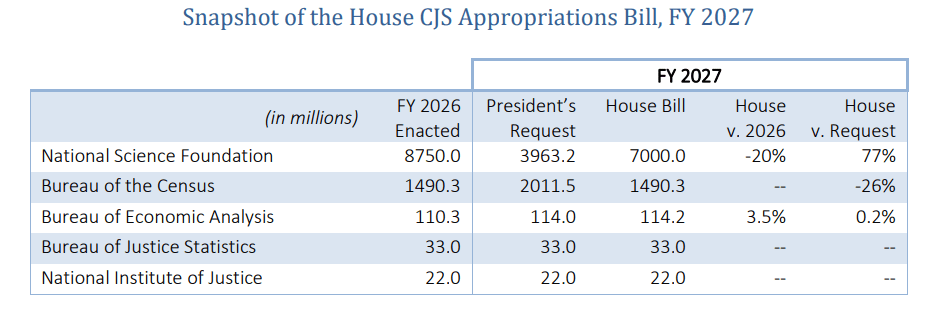
The House Appropriations Committee has begun consideration of its fiscal year (FY) 2027 appropriations bills. The Committee is working to approve all 12 funding bills by the end of June. On May 13, the Appropriations Committee reported out the FY 2027 Commerce, Justice, Science (CJS) Appropriations Bill, which includes funding proposals for the National Science Foundation (NSF), Census Bureau, National Institute of Justice (NIJ), Bureau of Justice Statistics (BJS), and other agencies.
As we saw last year, the FY 2027 House CJS bill includes cuts to federal science agencies but does not go as far as the President’s budget request, which proposed massive reductions, specifically to NSF (see COSSA’s full analysis of the President’s FY 2027 budget request to Congress).
On the other side of the Capitol, the Senate Appropriations Subcommittees are busy drafting their own FY 2027 bills. While not scheduled yet, the Senate Appropriations Committee is reportedly seeking to start considering their bills in June.
Read on for COSSA’s analysis of the House CJS Appropriations bill. The bill language and accompanying report are available here.
Stay tuned to COSSA’s coverage for the latest developments.
Action Alert Reminder: Tell Congress to Save NSF’s Social, Behavioral, and Economic Sciences Directorate!
In early April, the Trump Administration released its budget request for fiscal year (FY) 2027. In it, the Administration states its intent to dismantle the National Science Foundation’s (NSF) Social, Behavioral, and Economic Sciences (SBE) Directorate in FY 2027. The SBE Directorate is responsible for nearly two-thirds of funding for academic research in the social and behavioral sciences in the U.S. However, even more concerning are reports that NSF leadership may be taking steps to begin dismantling the Directorate this year. In response to this news, COSSA immediately issued an action alert that has resulted in more than 2,000 letters being sent to Congress.
Now is the time to come together as a community and urge Congress to intervene and protect the SBE Directorate from the Administration’s devastating plan. Join the over 2,000 advocates and write to your House Representative and Senators TODAY to share your concerns and urge them to intervene.
Congress Turns to Appropriations After Returning from May Recess
Following a week-long May recess, Congress has turned their attention toward the fiscal year (FY) 2027 appropriations process. As previously reported, the House has set their schedule for advancing their appropriations bills through May and June. On May 13, the House Appropriations Committee reported out the Commerce, Justice, and Science, and Related Agencies (CJS) budget bill—which includes funding proposals for the National Science Foundation (NSF), the Census Bureau, and more (see related article). The Committee is also scheduled to review the Labor, Health and Human Services, Education, and Related Agencies (LHHS) budget bill—which includes funding proposals for the National Institutes of Health (NIH), Centers for Disease Control and Prevention (CDC), Institute of Education Sciences (IES), and more—in early June.
On the other side of Capitol Hill, the Senate has reportedly started drafting their respective bills and could schedule mark ups as soon as June. While Congress is currently on-schedule to complete the appropriations process, it is still unlikely that the community will see any final appropriations bills before the midterm elections in November.
In related news, election season has already started to shake up key committees important to the research community. Over the weekend, Senator Bill Cassidy (R-LA), who serves as the Chair of the Senate Health, Education, Labor and Pensions (HELP) Committee, lost in the Louisiana Senate Republican primary election. Notably, the Senate HELP Committee is charged with oversight of several scientific agencies, including the Department of Health and Human Services (HHS) and the Department of Education. In Sen. Cassidy’s absence, there will be a leadership vacuum that could signal a change in priorities for the next Congressional session.
Stay tuned for COSSA’s continued coverage on Congressional activities.
🔦 SPOTLIGHT ON NSF: Scientific Community Fights for NSF
It has been a particularly challenging few months for the National Science Foundation (NSF), between a massive, proposed budget cut, removal of members of the National Science Board (NSB), and the proposal to eliminate the Social, Behavioral, and Economic Sciences Directorate (SBE). The research community has spent much of the Spring pushing back and urging Congress to defend NSF.
Saving the SBE Directorate
COSSA along with our many partners across the STEM enterprise have been working tirelessly to urge Congress to reject the President’s proposal to eliminate the SBE Directorate in FY 2027. With House and Senate appropriators currently at work on their FY 2027 funding bills, we have been busy meeting with Congressional offices to make the case about the importance of SBE and social and behavioral science generally.
We are fortunate to have dedicated partners across the sciences who are willing to assist in our efforts. Earlier this month, about 40 scientific societies spanning the physical, biological, and computer sciences, mathematics, and engineering fields signed a letter to the House and Senate appropriations committees urging them to reject the President’s proposal in their FY 2027 appropriations bills (see related articles). The letter states, “Many of the nation’s most pressing policy questions have a scientific or technological component that needs to be understood through a human lens, including through integrated modeling and design approaches that combine technical systems with human behavior. That is where the research that SBE supports comes into play, providing crucial data and theoretical frameworks that inform work across the entire research enterprise, including the biological, computer and information sciences, engineering, and the mathematical and physical sciences.”
Another letter sent recently to Capitol Hill notes, “SBE research is a force multiplier for federal investments in science and technology. Advances in artificial intelligence, public health, energy, cybersecurity, and defense depend not only on technical breakthroughs, but also on understanding how individuals, organizations, and societies respond to new technologies and policies.”
COSSA is collecting these and other statements in support of SBE on our Save SBE website.
National Science Board
As previously reported, in April the Trump Administration dismissed all 22 members of the National Science Board, the policymaking and oversight body of the National Science Foundation (NSF). Here, too, the scientific community has responded in force, calling on Congress to assert its oversight authority by directing NSF to explain this decision and, as recommended by some groups, reverse it. In addition to countless statements issued in response to the action, including one by COSSA, is a letter signed by former NSF directors and NSB chairs as well as an open letter led by members of the National Academies of Sciences, Engineering and Medicine (NASEM). Democrats in the House and Senate have also sent letters to the Administration requesting answers to several questions about move, including the legal and constitutional basis for the terminations and information on how the decision was made.
NSF Director
NSF has been without a confirmed director for more than a year. This coupled with the firing of the National Science Board means that all of the decisions being made at NSF, including reorganization, the proposal to eliminate the SBE Directorate, changes to the merit review process, and the move to new office space, are being directed by acting leadership and the White House.
The President nominated Jim O’Neill earlier this year to be the next NSF director. O’Neill is not the typical pick for the NSF post as he does not come from the scientific community and does not appear to have experience in basic science. Given how little is known about O’Neill and his plans for NSF, advocates have been urging Congress to hold a hearing with the nominee before a confirmation vote. NSF director nominees traditionally have not had confirmation hearings, although previous nominations were of individuals already familiar with NSF.
Reorganization
After more than nine months, NSF finally released details of its reorganized directorate leadership. As COSSA as been reporting, NSF’s interim leadership made several changes to across the agency over the last year, including the removal of “rotators” from supervisory positions. Most recently, rotators comprised six of the eight assistant directors leading NSF’s directorates. Under the new structure, which was said to have been implemented last August but not made public until recently, rotators have been removed from their leadership roles and replaced with “career” employees who now serve as “directorate heads.” Former assistant directors who are rotators will keep their title but serve in more of an advisory role. The current list of directorate heads is available here. Notably, the SBE Directorate is the only one that does not also have a deputy directorate head and/or assistant director.
Nominations Open for 2026 NIH Matilda White Riley Honoree
The Office of Behavioral and Social Sciences Research (OBSSR) at the National Institutes of Health (NIH) is now accepting nominations for outstanding behavioral and social scientists as Distinguished Lecturer candidates at the 19th Matilda White Riley Honors.
The Matilda White Riley Honors are an annual event recognizing transformative work in the fields of social and behavioral science along with early-career researchers. Nominees should have a research career that has “advanced behavioral and social scientific knowledge in areas within NIH’s mission and that expands upon Dr. White Riley’s work.” More information is available on the OBSSR website.
Nominee information should be saved as a PDF file and sent to Dr. Erica Spotts by May 28. Self-nominations will not be accepted.
The State of U.S. Science and Engineering 2026 Released
The National Science Board (NSB) recently released The State of U.S. Science and Engineering 2026 report. Every two years, the NSB prepares this report, which examines the state of U.S. science and engineering over time and within a global context. It summarizes key findings in areas such as education and workforce; U.S. and international research and development performance, including in high-tech industries; and technology transfer, invention and innovation.
In the 2026 report, the NSB highlights many key takeaways including:
- The STEM workforce grew faster than the non-STEM workforce between 2014 and 2024 and now accounts for roughly 26% of total domestic employment.
- STEM workers experienced lower unemployment and higher median earnings than workers in other occupations.
- Average scores on national mathematics and science assessments for K–12 students have declined from their pre-pandemic levels, and U.S. eighth graders performed at or below the international average on science, mathematics, and computer and information literacy assessments in 2023.
This report, the thematic reports, and the online data tool together make up the full suite of products. You can access them on the NSB website.
Social Science Research Council Names Daniel Goroff as President
On May 18, the Social Science Research Council (SSRC) named Daniel Goroff as its 16th president. Prior to his appointment, Goroff served as the Vice President and Program Director at the Alfred P. Sloan Foundation, Deputy Director for Science and Society at the White House Office of Science and Technology Policy (OSTP), and Division Director for Social and Economic Sciences at the National Science Foundation (NSF). About his appointment, Goroff stated:
“For more than a century, the Social Science Research Council has been a force for good by fostering inquiry, marshaling evidence, and helping turn research insights into public impact. Today’s global challenges call for even more and better ideas about how people can live, work, and thrive together. With humility and a deep sense of responsibility to our academic and philanthropic partners, I see the SSRC as having a unique role to play — building on our storied past, on our extraordinary portfolio of current work, and on the bold new initiatives we will launch together.”
SSRC is a COSSA member organization. “Danny has dedicated his career to service and is a stalwart champion for the social and behavioral sciences,” said COSSA Executive Director Wendy Naus. “I’m excited to work with him in this new role.”