
Issue 13 (June 24)
President Trump Executive Actions
Trump Administration Actions (all actions available here):
- Inaugurating the Era of Super Intelligence (9/29/26)
- Enhancing Program Integrity and Interagency Coordination in the Administration of the H-1B Nonimmigrant Visa Program (9/18/26)
- Restoring Trust in the Smithsonian Institution (7/24/26)
- Implementing Schedule Policy/Career in the Excepted Service (6/3/26) (MORE INFORMATION)
- Promoting Advanced Artificial Intelligence Innovation and Security (6/2/26)
- Addressing DEI Discrimination by Federal Contractors (3/26/26)
- Addressing Addiction through the Great American Recovery Initiative (1/29/26)
- Memorandum: Withdrawing the United States from International Organizations, Conventions, and Treaties that are Contrary to the Interests of the United States (1/7/26)
- Increasing Medical Marijuana and Cannabidiol Research (12/18/25)
- Ensuring a National Policy Framework for Artificial Intelligence (12/11/25) (MORE INFORMATION)
- President’s Management Agenda (12/8/25) (MORE INFORMATION)
- Launching the Genesis Mission (11/24/25) (MORE INFORMATION)
- Ensuring Continued Accountability in Federal Hiring (10/15/25)
- Fiscal Year (FY) 2027 Administration Research and Development Budget Priorities and Cross-Cutting Actions (9/23/25) (MORE INFORMATION)
- Restriction on Entry of Certain Nonimmigrant Workers (9/19/25)
- Memorandum: Use of Appropriated Funds for Illegal Lobbying and Partisan Political Activity by Federal Grantees (8/28/25)
- Improving Oversight of Federal Grantmaking (MORE INFORMATION) (8/7/25)
- Ensuring Transparency in Higher Education Admissions (MORE INFORMATION) (8/7/25)
- Preventing Woke AI in the Federal Government (MORE INFORMATION) (7/23/25)
- Creating Schedule G in the Excepted Service (7/17/25) (MORE INFORMATION)
- Memorandum: Ensuring Accountability and Prioritizing Public Safety in Federal Hiring (7/7/25)
- Establishing the President’s Make America Beautiful Again Commission (7/3/25)
- Enhancing National Security by Addressing Risks at Harvard University (6/4/25)
- Restricting the Entry of Foreign Nationals to Protect the United States from Foreign Terrorists and Other National Security and Public Safety Threats (6/4/25)
- Restoring Gold Standard Science (5/23/25) (MORE INFORMATION)
- Increasing Efficiency at the Office of the Federal Register (5/9/25)
- Improving the Safety and Security of Biological Research (5/5/25)
- Improving the Safety and Security of Biological Research (5/5/25)
- Strengthening Probationary Periods in the Federal Service (4/24/25)
- White House Initiative to Promote Excellence and Innovation at Historically Black Colleges and Universities (4/23/25)
- Reforming Accreditation to Strengthen Higher Education (4/23/25)
- PROPOSED RULE: Improving Performance, Accountability, and the Civil Service (4/23/25)
- Transparency Regarding Foreign Influence at American Universities (4/23/25)
- Extension of Hiring Freeze (4/17/25)
- Restoring Truth and Sanity to American History (3/27/25) (MORE INFORMATION)
- Improving Education Outcomes by Empowering Parents, States, and Communities (3/20/25) (MORE INFORMATION)
- Continuing the Reduction of the Federal Bureaucracy (3/14/25) (MORE INFORMATION)
- Additional Rescissions of Harmful Executive Orders and Actions (3/14/25)
- Implementing the President’s DOGE Cost Efficiency Initiative (2/26/25) (MORE INFORMATION)
- Ensuring Lawful Governance and Implementing the President’s DOGE Deregulatory Initiative (2/19/25) (MORE INFORMATION)
- Radical Transparency about Wasteful Spending (2/18/25) (MORE INFORMATION)
- Establishing the President’s Make America Healthy Again Commission (2/13/25)
- Implementing the President’s “Department of Government Efficiency” Workforce Optimization Initiative (2/11/25) (MORE INFORMATION)
- Advancing United States Interests When Funding Nongovernmental Organizations (2/6/25) (MORE INFORMATION)
- Ending Radical Indoctrination in K-12 Schooling (1/29/25)
- President’s Council of Advisors on Science and Technology (1/23/25)
- Removing Barriers to American Leadership in Artificial Intelligence (1/23/25)
- Ending Illegal Discrimination and Restoring Merit-Based Opportunity (1/21/24) (MORE INFORMATION)
- Ending Radical and Wasteful Government DEI Programs and Preferencing (1/20/25)
- Defending Women from Gender Ideology Extremism and Restoring Biological Trust to the Federal Government (1/20/25)
- Establishing and Implementing the President’s “Department of Government Efficiency” (1/20/25)
- Restoring Accountability to Policy-Influencing Positions within the Federal Workforce (1/20/25) – Reinstates Trump Administration’s 2020 EO creating a new Schedule F in the Federal Excepted Service
- Withdrawing the U.S. from the WHO (1/20/25)
- Putting America First in International Environmental Agreements (1/20/25) – Withdraws the U.S. from the Paris Climate Accord, among other actions.
- Hiring Freeze (1/20/25) (MORE INFORMATION)
- Return to In-Person Work (1/20/25) (MORE INFORMATION)
- Restoring Freedom of Speech and Ending Federal Censorship (1/20/25)
- Initial Rescissions of Harmful Executive Orders and Actions (1/20/25) – Rescinds dozens of Biden Administration Executive Orders
Find COSSA’s full list of Trump’s Executive Actions and more information here or on the Social Science Space Tracker.
COSSA Releases Part 1 of the President’s FY 2026 Budget Request for Social and Behavioral Science Analysis
On May 3, the Trump Administration released preliminary, high-level details of its fiscal year (FY) 2026 budget request, referred to as a “skinny budget.” On May 30, additional details emerged. Given the delay in this year’s budget release, COSSA is delivering its annual analysis of the President’s budget request in two parts. This first part contains our analysis of the Trump Administration’s FY 2026 funding proposals for the Department of Education, Department of Health and Human Services, National Institutes of Health, and National Science Foundation. The second part will include details on all remaining agencies important to the social and behavioral science community.
The President’s FY 2026 budget reiterates the Administration’s commitment to “reducing waste” and “improving efficiency” through targeted investments in specific areas and major funding terminations for initiatives that do not align with the President’s policy positions (e.g., DEI). If Congress enacts the President’s proposal, nearly every federal agency would see large cuts to their budgets in FY 2026. However, many of the proposals, such as a 40 percent cut to the National Institutes of Health, are viewed as nonstarters with bipartisan champions in Congress.
When considering an Administration’s budget proposal, it is important to remember that it remains a largely symbolic policy document outlining the Administration’s priorities for the year ahead. While it is possible that some of the President’s requests will be enacted, Congress has the final say over the appropriation of funds. The House and Senate Appropriations Committees have already begun marking up their annual appropriations bills, with the science-related funding bills scheduled for consideration in early July.
Still, given the ongoing gridlock in Congress, it remains unlikely that FY 2026 appropriations bills will be completed on time (i.e., by October 1). FY 2026 is all but guaranteed to begin under a continuing resolution (CR) come October 1.
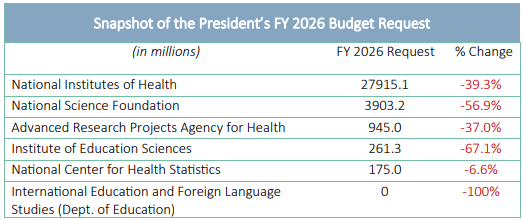
COSSA will continue to report on the progress of FY 2026 funding legislation in the weeks and months ahead. In the meantime, we invite you to read our analysis to learn about the President’s proposals as they pertain to social and behavioral science research.
REGISTER NOW: Headlines Webinar on June 26
On June 26, join COSSA for the next installment in the Headlines Webinar series. This month’s meeting will focus on the release of the President’s fiscal year (FY) 2026 budget and what it means for the social and behavioral sciences. Come join the conversation.
Featured speakers:
- Christy Talbot, Assistant Director of Government Relations at the American Educational Research Association
- Steve Pierson, Director of Science Policy for the American Statistical Association
- Wendy Naus, Executive Director of COSSA
The webinar will be taking place on June 26 at 2pm EST. Register here.
Headlines is a webinar series available to COSSA member organizations. Watch for additional webinar announcements, and previous webinar recordings, on the COSSA website.
House Republicans Delay Markups; Reconciliation Subject to “Byrd Bath”
As previously reported, the fiscal year (FY) 2026 appropriations process is well underway with the House reviewing multiple bills, most recently the Agriculture, Rural Development, Food and Drug Administration, and Related Agencies bill; the Military Construction, Veterans Affairs, and Related Agencies bill; the Homeland Security bill; the Defense bill, and the Legislative Branch bill. The House has also released subcommittee allocations—or topline funding levels—for the bills already drafted. The other subcommittees have yet to receive their allocations, including the Labor, Health and Human Services, and Education (LHHS) and Commerce, Justice, and Science (CJS) subcommittees. On June 18, the House Appropriations committee announced a delay in their markup schedule.
In other news, both the House and the Senate are reviewing changes to the Big Beautiful Bill Act, which was originally passed through the House (see previous COSSA coverage). In anticipation of the bill violating reconciliation guidelines, the House reviewed and removed various provisions from the bill, passing it through the chamber for a second time on June 11. The following week, the Senate released their version of the Big Beautiful Bill, which included several changes to the House’s legislation. The Senate was expected to vote on the bill later this week; however, on June 22, the Senate Parliamentarian announced that certain provisions within the bill still violated reconciliation rules and would be subject to the Byrd Rule. This included a section of the bill that would allow the executive branch to reorganize federal agencies without Congressional oversight and a provision that would increase the Federal Employees Retirement System (FERS) contribution rate if new civil servants did not agree to become “at-will” employees (a list of these provisions can be found here). To waive the parliamentary challenges would require the usual 60 super-majority vote, so it is expected that these provisions will be removed from the bill in what is referred to colloquially as a “Byrd Bath”. It is unclear whether the Big Beautiful Bill will overcome these hurdles by the Republicans’ self-imposed deadline of the Fourth of July.
Stay tuned to COSSA’s continued coverage of Congressional activities.
Bhattacharya Defends NIH Budget Request to Senate Appropriators
As the Congressional appropriations process continues, Dr. Jay Bhattacharya, Director of the National Institutes of Health (NIH), was invited to defend the President’s FY 2026 before the Senate Labor, Health and Human Services, Education, and Related Agencies (LHHS) Appropriations subcommittee (see COSSA’s analysis). Under the President’s budget, the NIH would see steep budget cuts and a major restructuring that would reduce the institutes and centers (ICs) from 27 to 8. Throughout the hearing, Bhattacharya fielded questions on the impacts of these proposals on the research community and dismissed concerns, claiming that the proposal is the starting point of a budget negotiation.
Several points of contention are currently under litigation, including the proposal to cap indirect costs at 15 percent and the proposal to reorganize the NIH, restricting Bhattacharya’s ability to speak directly on those issues.
In her opening statement, Chairwoman Shelley Moore Capito (R-WV) acknowledged the “difficult” appropriations season ahead of them and emphasized the importance of biomedical research in U.S. economic activity, while Ranking Member Tammy Baldwin (D-WI) raised concerns over the almost 40 percent cut to NIH’s budget under the proposal. Bhattacharya emphasized his commitment to addressing America’s greatest health concerns, prioritizing chronic disease prevention; however, he failed to assure the Committee how the NIH could operate with such steep cuts. Sen. Baldwin continued her line of questioning, to which Bhattacharya affirmed that it is his decision which NIH grants are being cut under the Administration’s new guidelines (see list of Trump’s Executive Orders here).
As raised in recent hearings with the Department of Health and Human Services Secretary Robert F. Kennedy, several Democratic members of the committee questioned Bhattacharya on current-year funding (FY 2025), raising concerns over the legality of the budget cuts being made by the Trump Administration. Questions from Sen. Dick Durbin (D-IL) and Jeff Merkley (D-MA) about frozen funding on research across the country prompted reassurances from Bhattacharya, who claimed he is “turning on every light switch” he can find to support scientific research. The hearing can be viewed here.
All Eyes on Indirect Costs
On June 17, Republican leaders of the House Science, Space and Technology Committee sent a letter to the Government Accountability Office (GAO) requesting that the non-partisan “Congressional watchdog” conduct a comprehensive review of the indirect costs associated with federal research funding. The request comes amid increased attention by lawmakers on indirect costs following the Trump Administration’s effort to set a flat 15 percent rate for facilities and administrative (F&A) costs for grants awarded by the National Institutes of Health (NIH), National Science Foundation (NSF), Department of Energy (DOE), NASA, and Department of Defense (see previous coverage). These efforts are currently stalled as a result of lawsuits brought by research and higher education groups.
Leaders across the research and higher education community responded to Trump Administration actions by forming a group to explore potential new F&A models that could serve as an alternative to the Administration’s across-the-board cut. The Joint Associations Group (JAG) on Indirect Costs has engaged researchers across the scientific and higher education communities over the last few months to inform their recommendations, which were released during a set of webinars earlier this month. A recording of the two recent webinars are is available here.
The Science Committee letter did not provide a timeframe for the GAO report, although reports can take three months or longer to complete once requested by Congress.
COSSA will continue to follow this issue.
Latest from the White House (June 24)
‘Forward Funding’ by NIH the New Norm?
As COSSA has been reporting, the Trump Administration released details of its fiscal year (FY) 2026 budget proposal last month (see related article), which not only includes major funding reductions for federal science agencies, but also major shifts in policy. One such shift is how research grants would be funded by the National Institutes of Health (NIH).
According to the NIH budget request, the agency plans to “continue the FY 2025 policy of reserving half of NIH funding allocated toward competing research project grant (RPG) awards for awards that fully fund their outyear commitments as part of the initial grant obligation, to facilitate efficient management of resources across multiple years.” In other words, if you are among the few researchers awarded NIH grants in FY 2026, you may receive funding to cover the duration of the project in year one instead of incrementally over five years, for example.
The Administration estimates that between the proposed budget cuts to NIH, reinstatement of a 15 percent cap on direct costs, and fully funding half of its grants in FY 2026, NIH could support 4,312 competing research project grants (RPGs), a decrease of about 30 percent, and 22,183 noncompeting RPGs, which would be about 27 percent fewer projects than in FY 2025. The budget also estimates that with a 15 percent cap on indirect costs (which continues to be hotly debated, see related article), the average cost for competing awards in FY 2026 would be reduced by about 11 percent to $863,000.
As COSSA has said many times, the President’s budget request is just one proposal on the table; at the end of the day Congress has the final say over FY 2026 appropriations. House and Senate appropriators are working now to craft their spending bills (see related article) which may or may not include provisions pertaining to these NIH policy proposals.
NIH Employees Outline Concerns in ‘Bethesda Declaration’
On June 9, more than 340 scientists and staff at the National Institutes of Health (NIH) issued a statement criticizing their agency’s leadership for politicizing research. The “Bethesda Declaration,” which as of today includes 484 signatories, urges NIH Director Jay Bhattacharya and other leaders to reverse course on budget reductions, workforce terminations, elimination of research related to DEI, undermining of the peer review process, and instituting a blanket 15 percent indirect cost rate, among others. It is exceptionally rare for federally employees to publicly protest and criticize their own agency.
In response, an open letter in support of the Bethesda Declaration has been circulating among the extramural research community, garnering more 28,000 signatures at the time of this writing, including dozens of Nobel Laureates, members of Congress, former federal agency officials, and others. Additional signatures are being collected here.
Kennedy Fires Then Appoints New Members Vaccine Committee
Earlier this month, the Department of Health and Human Services (HHS) Secretary, Robert F. Kennedy Jr., dismissed all 17 members of the HHS Advisory Committee on Immunization Practices (ACIP), a federal panel that makes vaccine policy recommendations to the Centers for Disease Control and Prevention (CDC). The committee was formed in 1964 and has largely been comprised of experts in medicine, public health, and immunology.
Following the abrupt decision, Secretary Kennedy announced in a post on X (formerly Twitter) the appointment of 8 new members to the committee, including Joseph R. Hibbeln, MD; Martin Kulldorff, MD, PhD; Retsef Levi, PhD; Robert W. Malone, MD; Cody Meissner, MD; James Pagano, MD; Vicky Pebsworth, OP, PhD, RN; and Michael A. Ross, MD. It is unclear how the members of the committee were selected.
Nearly all of the newly appointed members have a history of anti-vaccine rhetoric, including Levi and Malone, who have both publicly pushed false claims that the COVID-19 vaccines led to serious harm and death during the pandemic. Pebsworth also serves on the board of the National Vaccine Information Center, a non-profit accused of promoting vaccine misinformation, and Kulldorff who, alongside NIH Director Jay Bhattacharya and other authors, wrote the Great Barrington Declaration, which urged herd-immunity in lieu of shutdowns during the COVID-19 pandemic. The newly appointed ACIP is scheduled to meet June 25-27 to discuss the COVID-19 vaccines, among others. The meeting can be viewed virtually here.
Stay tuned to COSSA’s continued coverage of the new Administration.