
Issue 13 (June 30)
COSSA’s Analysis of the FY 2027 House LHHS Appropriations Bill for Federal Science Agencies
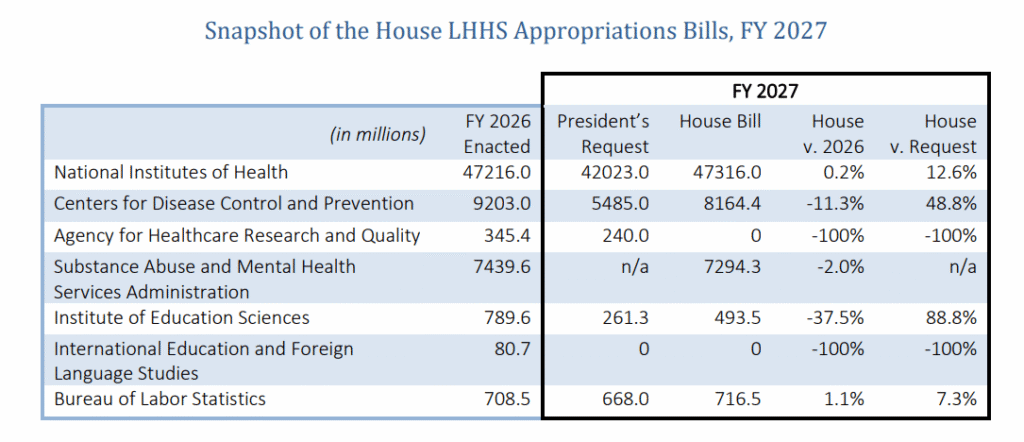
On June 9, the House Appropriations Committee advanced its version of the fiscal year (FY) 2027 Labor, Health and Human Services, Education, and Related Agencies (LHHS) Appropriations bill, which provides annual appropriations for the National Institutes of Health (NIH), Centers for Disease Control and Prevention (CDC), Department of Education, Department of Labor, and other agencies. This is the latest bill advanced by the Committee as part of Chairman Tom Cole’s (R-OK) plan to consider all 12 annual spending bills by the July 4 break. While the Senate was scheduled to begin marking up their bills this month, more pressing issues delayed the chamber which postponed its bills indefinitely.
The House bill is a mixed bag for the science agencies important to the COSSA community. This year, the Committee rejects the President’s proposals to reduce the NIH budget by more than 10 percent and cut CDC by nearly half. The bill again rejects Trump’s plan to reorganize the Department of Health and Human Services (HHS); the President’s FY 2027 budget request included an extensive reorganization of HHS introducing new entities (e.g., Administration for a Healthy America) and consolidating several agencies. Still, the House proposal includes a significant cut for the Institute of Education Sciences and other agencies and programs.
Now that we are heading into the summer months, there will be far fewer days for lawmakers to work on FY 2027 funding legislation before the start of the new fiscal year on October 1. With August recess and the November midterm elections looming, Fiscal Year 2027 is all by certain to begin under a continuing resolution (CR). The details of such a funding patch remain far from decided at this point.
Read on for COSSA’s analysis of the House LHHS appropriations bill and how it compares to the President’s budget request and current funding. Text of the bill and accompanying report is available here.
Stay tuned to COSSA’s coverage for the latest developments.
Register Now: Guidance on OMB’s Proposed Rule
On July 1, join COSSA for the next Headlines Webinar focused on providing guidance on the White House Office of Management and Budget’s (OMB) Proposed Rule.
OMB issued a proposed rule in late May that would make major changes to the Uniform Guidance governing federal financial assistance, including federal research grants. The rule seeks to implement proposals made by the Trump Administration through various executive orders and other actions taken since January 2025. Public comments are being accepted through July 13. This webinar will provide COSSA members with guidance on how best to respond to the proposed rule.
Register now and join the conversation.
Headlines is a webinar series available to COSSA member organizations. Watch for additional webinar announcements, and previous webinar recordings, on the COSSA website.
Kristen Olson Answers “Why Social Science?”

The most recent Why Social Science? post comes from Dr. Kristen Olson from the University of Nebraska, Lincoln about how asking the right questions and using surveys will help us better understand and support populations we want to study.
Read on for more.
Senate Departs for July Recess After Appropriations Markups Delayed
Over the weekend, the Senate departed Capitol Hill for a two-week July 4 recess, and are not scheduled to return until July 13, leaving only a few weeks until August recess to consider their appropriations bills. Before their departure, the Senate Appropriations Committee again delayed consideration of the Commerce, Justice, Science, and Related Agencies (CJS) appropriations bill for fiscal year (FY) 2027. The bill, which was originally scheduled for June 4 and rescheduled for June 25, was postponed alongside several other appropriations bills (see previous coverage).
According to recent reports, the Senate Republicans’ dwindling majority amidst the recent hospitalization of Senator Mitch McConnell (R-KY), Chair of the Senate Defense Appropriations Subcommittee, contributed to the delays. Further, without an agreement on top-line spending allocations, it’s unclear if the Senate will have the support they need to advance their more controversial appropriations bill out of committee—including the CJS and Labor, Health and Human Services, and Education (LHHS) bills. Midterm elections could also complicate the process as legislators up for re-election could return to the campaign trail as early as October. The House Appropriations Committee passed all twelve of its respective appropriations bills; several of these bills included steep cuts to federal agencies important to the social and behavioral science research community (see analyses here). Still, we remain far off from any final decisions on FY 2027 funding.
In related news, late last week President Trump declined to sign into law the 21st Century Road to Housing Act (H.R. 6644), a bipartisan housing affordability and development bill, and announced that he would not sign any new bills into law until Congress passes the SAVE Act (H.R. 22), which seeks to require proof of U.S. citizenship to vote during federal elections. This is not the first time President Trump has stalled legislative activity over the SAVE Act; during the Department of Homeland Security (DHS) partial government shutdown, he also pledged to not sign any bills into law until the voter I.D. bill was passed (see previous coverage).
On June 29, House Speaker Mike Johnson (R-LA) unveiled a plan to attach the SAVE Act to the National Defense Authorization Act (NDAA). As the bill is unlikely to gain the support it would need to pass in the Senate when they return, House Speaker Johnson has stated that Republicans will also consider attaching the SAVE Act to a third reconciliation bill, which has drawn criticism from both sides of the aisle. As previously reported, the Trump Administration signed into law the One Big Beautiful Bill Act (H.R. 1) on July 4, 2025, which reallocated resources in order to pay for permanent tax cuts and increase funding for border security activities, and the House Republicans are already in the process of drafting a second reconciliation bill to provide additional funding to the Department of Defense (DOD) (see previous coverage). With Congress turning their attention to the SAVE Act, this could become another obstacle for Congress to pass the FY 2027 appropriations bills before the end of the fiscal year on September 30.
Stay tuned for COSSA’s continued coverage of the FY 2027 appropriations process.
House Science Investigations and Oversight Subcommittee Holds Hearing on Federal Research Funds
On June 24, the House Science, Space, and Technology (SST) Subcommittee on Investigations and Oversight held a hearing titled, Investigations and Oversight Subcommittee Hearing – Safeguarding Federal Research Funds: The False Claims Act’s Role in Combating Grant Fraud. Witnesses included Robert Steinau, Senior Official Performing the Duties of Inspector General, National Aeronautics and Space Administration (NASA) Office of the Inspector General; Jennifer Springmann, Special Agent in Charge, National Science Foundation (NSF) Office of the Inspector General; and Brenna Jenny, Deputy Assistant Attorney General for Commercial Litigation Branch, Department of Justice (DOJ).
Chairman Rich McCormick (R-GA) began the hearing by expressing concern about “fraudulent grants” and repeatedly emphasized the “waste, fraud, and abuse” of taxpayers’ dollars, urging the committee to investigate further. He encouraged the DOJ to prioritize preventative measures against grant fraud, rather than punishment after fraud has been committed.
Ranking Member Emilia Sykes (D-OH) followed Chair McCormick by questioning the committee’s concern with grant “fraud” while Congress overlooks what she takes to be more critical examples of fraud within the Trump Administration. Further, Ranking Member Sykes argued that the Administration was misusing the False Claims Act (FCA) to hide their attempts to punish researchers who don’t align ideologically with the Administration. On a similar note, House SST Ranking Member Zoe Lofgren (D-CA) agreed that the “fraud is coming from inside the house.”
Ms. Jenny was questioned by several Democratic members regarding her stance on Diversity, Equity, and Inclusion (DEI) as grounds for DOJ cases against research institutions. On the other side of the aisle, several Republican members questioned Ms. Jenny about the quantity of funds her department has recovered through use of the FCA and what methods for seeking out fraud cases recovered the most funds.
Members of the Committee also raised concerns about research institutions’ use of foreign funds and how grant application fraud could put “meritorious” grant allocations in jeopardy. Ms. Springmann and Mr. Steinau both raised concerns that foreign funding was not being properly reported to the federal government, which they believe compromises the grant awarding process. They claimed that researchers who accept foreign funds are in less need of federal funding and argued that misreported foreign fund acceptance makes it more difficult for federal grants to be devoted to the best research.
Later, Representative George Whitesides (D-CA) questioned the witnesses on the Office of Management and Budget’s (OMB) recently proposed rule, Regulation for Federal Financial Assistance (see COSSA’s coverage here). Rep. Whitesides claimed that the rule is being complied with presently, despite it not being approved yet. For example, he mentioned rumors that White House Office of Science and Technology Policy (OSTP) officials are approving grants at NSF rather than scientists. Furthermore, Rep. Whitesides lamented the degradation of peer review processes, stating that “everyone who cares about science and what it brings to the world … should step up and fight back against the damage that is being done.”
During his line of questioning, Rep. Whitesides and Rep. Mike Haridopolos (R-FL) argued over the lack of federal grants awarded this year and the slow release of appropriated funds to federal agencies that fund scientific research. Chair McCormick claimed that the amount of grants awarded this fiscal year is comparable to other years.
A recording of the hearing can be found here. Stay tuned for COSSA’s continued coverage on federal research grants.
This article was contributed by COSSA Intern Caroline Seo.
Resources for Commenting on OMB Proposed Rule
As previously reported, the White House Office of Management and Budget (OMB) issued a proposed rule in late May that would make major changes to the Uniform Guidance governing federal financial assistance, including federal research grants. The rule seeks to implement proposals made by the Trump Administration through various executive orders and other actions taken since January 2025, many of great concern to the research community. Public comments are being accepted through July 13. COSSA is holding a members-only webinar on July 1 at 2:00 pm ET to provide guidance to members planning to comment.
As of this writing, more than 70,000 public comments have been submitted. Many scientific societies and professional associations are working on their statements and developing resources that the research community can use to assist in crafting individual comments, including (not a complete list):
Background Resources:
- AAAS Summary of Key Provisions
- The Planetary Society Comparison with Track Changes
- Ropes & Gray Key Takeaways
- Education Counsel webinar (recording), June 25
- Education Counsel FAQs
- National Council of Nonprofits Comparison
Tools & Tips for Submitting Public Comment:
COSSA strongly encourages all members to consider submitting comments and, whenever possible, use the comments to share specific examples of potential impact of the changed policies.
Have resources to share with the community? Send to COSSA.
NSF Seeks Comment on Grant Policy Revisions, Due Aug. 24
The National Science Foundation (NSF) is seeking public comment on proposed revisions to its grant policies. The changes are intended to bring NSF’s policy in line with the White House Office of Management and Budget’s sweeping proposed revisions to federal grant regulations released in late May (see related article). The draft would revise grant termination provisions, prohibit charging publication costs to awards, and eliminate references to fixed-price awards. It also clarifies that recovery of indirect costs on NSF awards is subject to the availability of funds, meaning organizations may not be able to recover their full negotiated indirect cost rates if award funding is insufficient. Additional changes implement new research security requirements and remove provisions tied to rescinded Biden-era Executive Orders.
Comments on the NSF proposal will be accepted through August 24, while comments on OMB’s proposed rule are due July 13.