
Issue 09 (May 5)
COSSA’s Analysis of the President’s FY 2027 Budget Request for Social and Behavioral Science
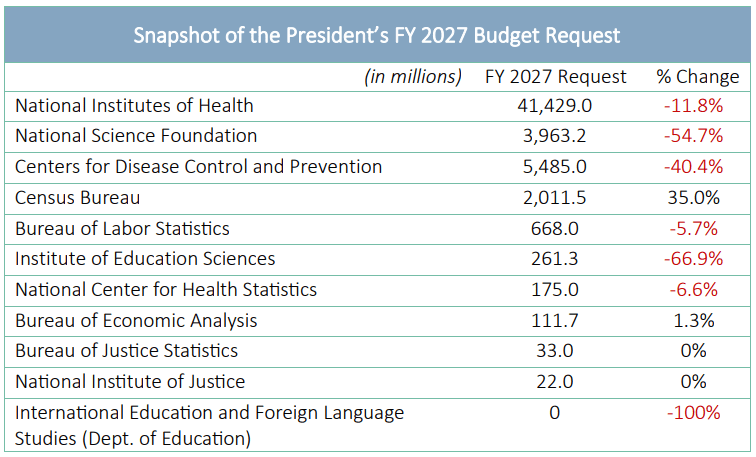
On April 3, the Trump Administration released its budget proposal for fiscal year (FY) 2027. The document released by the White House Office of Management and Budget (OMB) highlights actions the Administration has taken during its first year in office to cut spending across the federal government, stating that, “The full-year 2026 appropriations bills enacted the first real cut to spending in 12 years…[and] put us on a path to eliminate ineffective Federal agencies that do not serve a useful purpose…”
The FY 2027 budget seeks additional cuts, including a 10 percent reduction to non-defense discretionary spending, while proposing a staggering $1.5 trillion budget for national defense (a 44 percent increase).
With respect to federal science agencies, in some cases the budget proposes similar levels to the FY 2026 budget (which were ultimately rejected by Congress). For example, the budget once again proposes slashing funding for the National Science Foundation (NSF) by more than half and continues down the path of shuttering the Department of Education. In addition, the FY 2027 budget again seeks a major reorganization of the Department of Health and Human Services (HHS).
For other agencies, like the National Institutes of Health (NIH), the budget changes course. While still slated for a 12 percent cut under the proposal, this year’s request for NIH is a far cry from the 40 percent reduction sought last year by the Administration.
As always, when considering an Administration’s budget proposal, it is important to remember that it remains a largely symbolic policy document outlining the Administration’s priorities for the year ahead. While it is possible that some of the President’s requests will be enacted, Congress has the final say over the appropriation of funds.
COSSA will continue to report on the progress of FY 2027 funding legislation in the weeks and months ahead. You can follow our coverage here.
In the meantime, we invite you to read on to learn about the President’s proposals as they pertain to social and behavioral science research.
Advocates Answer “Why Social Science?”

The most recent Why Social Science? post comes from three participants from this year’s Social Science Advocacy Day who reflected upon their advocacy experiences and the importance of advocating for the social sciences.
Read on for more.
Meet COSSA’s Policy Intern: Malia Gunterman
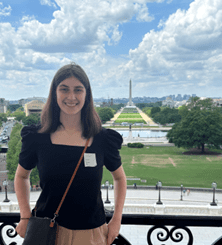
Malia Gunterman started as COSSA’s policy intern in January. Before she signs off and enjoys her summer, she provided some reflections from her time at COSSA.
How did you learn about COSSA and the opportunity to serve as a policy intern?
I learned about COSSA in my search for internship opportunities last summer. After discovering that my university is a COSSA member, I became interested in how social sciences might fit into my academic career. I was fortunate to connect with the COSSA team and become a policy intern for the Spring term.
How did the internship fit into your academic or career planning?
I am a rising Junior at Georgetown University studying International Politics with a concentration in Foreign Policy and minoring in French and Statistics. I knew what fields interested me individually before working with COSSA but have since developed a better idea of how I may apply my strengths and interests in politics and statistics to a career. I learned that social science lies at the root of everything, and it has been interesting to apply what I have learned at COSSA into my schoolwork.
What stood out to you most about your internship (i.e., did you learn anything interesting/eye opening or was there a task that you enjoyed most)?
I was initially attracted to the internship’s wide scope in subject matter. I was able to research the areas of social science that interested me most and meet professionals in the fields I want to enter. The hands-on experiences offered by this internship were invaluable. I attended meetings with Congressional staffers, reported on Senate and House Committee hearings, and researched issues facing social and behavioral science on the federal level. I greatly enjoyed the chance to see behind-the-scenes of the legislative process and advocacy work.
What would you tell future policy interns about the opportunity and/or about interning in-person in Washington, DC?
I implore future policy interns to take advantage of every opportunity their position offers. Whether that means attending a congressional hearing or listening in on a board meeting, gaining as many experiences as possible will make your internship that much more valuable. DC is a great place to learn and improve your academic and professional life. Professionals here are inviting and generally happy to share their experiences with young people interested in their work; don’t hesitate to grow your network as you consider what pathways you might take after your internship comes to an end.
What’s next for you?
I am eager to study abroad in Fall 2026 in Geneva, Switzerland to research International Studies and Multilateral Diplomacy. After studying abroad, I will continue my studies in DC. I hope to gain more experience in legislative politics and policy research before graduation in Spring 2028.
House Releases Science Funding Bill that would Slash NSF Budget
On April 30, the House Commerce, Justice, Science (CJS) Appropriations Subcommittee advanced their fiscal year (FY) 2027 CJS bill along party lines. The CJS bill includes funding proposals for the National Science Foundation (NSF), the Census Bureau, the Bureau of Economic Analysis (BEA), and the Office of Justice Programs (OJP). Notably, the House has once again rejected the 55 percent funding cut to NSF included in the President’s budget request; however, NSF would still see a 20 percent reduction under this bill.
Included in the bill are the following amounts:
- $7 billion to the National Science Foundation (NSF), a nearly 20 percent cut from the FY 2026 level.
- $1.49 million to the Census Bureau, which represents flat funding with the FY 2026 level;
- $119.5 million to the Bureau of Economic Analysis (BEA), which represents an increase of 1.3 percent above the FY 2026 level;
- $55 million to the Office of Justice Programs’ (OJP) Research, Evaluation, and Statistics account, which includes $33 million to the Bureau of Justice Statistics (BJS) and $22 million to the National Institute of Justice (NIJ). These amounts are equal to the FY 2026 appropriation.
More details are expected to be released in the coming weeks when the full House Appropriations Committee considers the bill on May 13. Stay tuned to COSSA’s continued coverage of the appropriations process.
HHS Secretary Defends FY 2027 Budget before House Energy and Commerce Committee
On April 21, Health and Human Services (HHS) Secretary Robert F. Kennedy Jr. defended the HHS fiscal year (FY) 2027 budget request to the House Energy and Commerce Committee, which provides oversight to public health agencies, including the National Institutes of Health (NIH) and the Centers for Disease Control and Prevention (CDC). Following his testimony to the House Labor, Health and Human Services, and Education (LHHS) Appropriations Subcommittee the previous week, Secretary Kennedy again highlighted several priority areas for the Administration, including vaccine efficacy, agriculture and food safety, rural health, national security, and the cost of health insurance and medicine in the United States.
During the hearing, Rep. Raul Ruiz (D-CA) questioned Secretary Kennedy’s ability to work with the new nominee for CDC Director, Dr. Erica Schwartz, who has a background in public health and deploying vaccines. This line of questioning comes after the abrupt termination of the previous CDC Director, Dr. Susan Monarez, last year (see previous coverage). Rep. Ruiz requested a promise from Secretary Kennedy to follow Dr. Schwartz’s vaccine guidance if confirmed and without interference, to which the Secretary refused.
Later, Rep. Lizzie Fletcher (D-TX), pressed Secretary Kennedy on the proposed funding cuts to several scientific research agencies in the President’s budget request, including NIH, and expressed concern that it would undermine biomedical research in the country and cede global leadership to countries like China. Further, Rep. Fletcher raised concerns on the impacts of the Trump Administration’s continued effort to set a flat 15 percent rate for facilities and administrative (F&A) costs for grants awarded by federal agencies. To this end, Secretary Kennedy argued that due to the overall national debt, the cuts and proposals outlined in the President’s budget request were necessary.
A recording of the hearing, as well as witness testimony, can be found here. Stay tuned for COSSA’s continued coverage of the appropriations process.
Trump Administration Fires National Science Board
On April 24, all 22 members of the National Science Board (NSB) received an email from the Trump Administration stating that they have been “terminated, effective immediately.” The NSB, which was established by statute in 1950, serves as the policymaking and oversight body of the National Science Foundation (NSF) and as an independent advisor to the President and Congress on federal science policy. COSSA issued a statement on the dismissal.
White House officials are stating that the decision responds to a 2021 Supreme Court case, U.S. v. Arthrex, that “raised constitutional questions about whether non-Senate confirmed appointees can exercise the authorities that Congress gave the National Science Board.” NSB members are presidentially appointed for six-year terms but do not require Senate confirmation. Legal experts are divided on whether the dismissal was justified.
The firing of the Board members is just the latest action aimed at NSF. The President’s budget request for fiscal year (FY) 2027 proposed a 55 percent cut to the NSF budget (see related article). In addition, the agency has been without a permanent director for more than a year and has seen most of its external advisory committees eliminated. Further, Trump’s nominee for NSF Director, Jim O’Neill, has not yet been considered by the Senate. The dismissal of the NSB exacerbates the leadership vacuum at NSF, all while its acting leadership continues to reorganize agency and shift priorities.
AAAS Accepting Nominations for 2027 Awards & Prizes
The American Association for the Advancement of Science (AAAS) announced that nominations are now open for the following awards and prizes:
- David and Betty Hamburg Award for Science Diplomacy
- Award for Scientific Freedom and Responsibility
- Newcomb Cleveland Prize
- Philip Hauge Abelson Prize
- Early Career Award for Public Engagement with Science
- John P. McGovern Award Lecture in the Behavioral Sciences
- Mentor Awards
- Mani L. Bhaumik Award for Public Engagement with Science
- Kavli Science Journalism Awards
AAAS also sponsors a wide range of other awards and prizes recognizing scientists, engineers, authors, journalists and public servants for significant contributions to science and the public’s understanding of science.
The deadline for all nominations is June 30, 2026 and winners will be announced in early 2027. Learn more on the AAAS website.