
Issue 07 (April 7)
A Note from COSSA
Friends – As I’m sure you have heard by now, the Trump Administration released its budget request for fiscal year (FY) 2027 last week, which seeks to boost military spending by more than 44 percent by slashing funding for domestic programs. Among the domestic accounts affected are federal science agencies for which, once again, the Administration has put forward budget proposals that would all but hand American science leadership to our global competitors. See the related article below for preliminary details about the budget request.
There will always be budget proposals by unsupportive Administrations seeking to cut funding for things they don’t view as priorities. But at the end of the day, Congress alone has the power to appropriate funding. In that sense, the FY 2027 budget is dangerous and not surprising, but also not insurmountable.
However, this year the threat is even more serious, potentially existential for the social and behavioral science community. The budget request states that the National Science Foundation (NSF) plans to dismantle the Social, Behavioral, and Economic Sciences (SBE) Directorate in FY 2027, which itself is alarming. However, recent reports and confidential sources have confirmed that NSF leadership (which is currently “acting” given no permanent NSF Director is in place) will begin the dismantling this year. Such a move raises several red flags and likely violates current statute, not to mention sidesteps Congress’ oversight and funding authority.
We will have a lot more to say about this development in the days and weeks ahead. For now, know that nothing is more important to COSSA than protecting the social and behavioral science community and the federal agencies that support it. We will be calling for your assistance as we fight these actions, and I hope you will join us.
Finally, COSSA will hold a virtual town hall meeting for member organizations on Tuesday, April 14 at 1:00 pm ET. To allow for as much candor and information sharing as possible, this meeting will be limited to those affiliated with COSSA member organizations (members register here). If you don’t see your organization on COSSA’s current membership list, please be in touch. At this challenging time, we need the community to come together as much as possible.
Thank you in advance for your assistance as we work collectively to ensure a brighter path forward for social and behavioral science research.
With gratitude,
Wendy Naus, Executive Director
Register Now: Understanding NSF’s Merit Review Updates with Wanda Ward
On April 9, join COSSA for the next Headlines webinar on changes to NSF’s Merit Review Process, the recently published “Merit Review for a Changing Landscape” Report, and what that means for social and behavioral science research. The webinar will feature specal guest Wanda Ward, Chair of the National Science Board’s Commission on Merit Review. Register now and join the conversation.
If you missed our March Headlines webinar covering recent policy developments and tips on how to advocate from home, you can find the recording here.
Headlines is a webinar series available to COSSA member organizations. Watch for additional webinar announcements, and previous webinar recordings, on the COSSA website.
Trump Proposes Steep Cuts to Federal Funding in FY 2027 Budget Request
On April 3, the Trump Administration transmitted its fiscal year (FY) 2027 budget request to Congress. Included in the budget request are significant cuts that would decimate the U.S. scientific enterprise, including a repeated proposal to slash the National Science Foundation’s (NSF) budget by more than half (see NSF’s budget proposal here). The Administration has also proposed eliminating funding for NSF’s Directorate for Social, Behavioral and Economic Sciences (SBE). Notably in previous appropriations bills, Congress has directed the agency to fully-fund the SBE directorate.
The Administration’s proposal also repeats several provisions and reorganization proposals from the previous year’s request, including a proposal to cap indirect costs at 15 percent and to create a new Administration for a Healthy America (AHA).
See the table below for a snapshot of the President’s budget request. Note that details remain limited for some federal departments and agencies and will be released in the weeks ahead. Stay tuned for COSSA’s full analysis of the President’s budget request in the coming weeks.
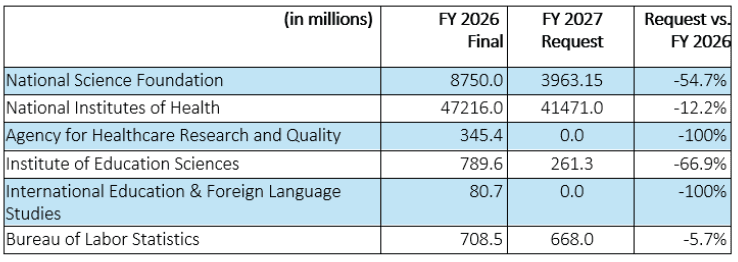
When considering an Administration’s budget proposal, it is important to remember that it remains a largely symbolic policy document outlining the Administration’s priorities for the year ahead. While it is possible that some of the President’s requests will be enacted, Congress has the final say over the appropriation of funds.
Sen. Welch Requests GAO Report on Impact of Scientific Research
On March 24, Senator Peter Welch (D-VT) sent a letter to the U.S. Government Accountability Office (GAO) requesting a full review of the economic, scientific, and national security impacts of the elimination of federal funding for scientific research. In the letter, he raised concerns about the Administration’s proposal of a 15 percent cap on indirect rates, arguing it would “cut $5 billion annually from university-based research nationwide”. Further, Sen. Welch highlighted the positive economic impact of scientific research, claiming that cuts to agencies like the National Institutes of Health (NIH) and National Science Foundation (NSF) would result in a loss of economic output between $10 and $16 billion annually, and significantly reduce American jobs. Federal funding, argued the Senator, is the “backbone” of the U.S. scientific research enterprise. To this end, Sen. Welch requested GAO produce a report that details the current state of research programs at colleges and universities and recent changes to available federal funding for grants and training programs, and the impacts of these changes on academic research output, workforce and economic development, U.S. global competitiveness, and research security.
NIH Requesting Comments on Strategic Plan
The National Institutes of Health (NIH) released a request for information (RFI) asking for stakeholder comments on the proposed framework for the NIH-Wide Strategic Plan for Fiscal Years (FYs) 2027-2031 slated for an FY 2027 release. Rather than focus on specific research opportunities or institute initiatives, NIH releases a strategic plan every five years to highlight the achievements of the agency and set broader priorities.
The proposed framework for the new strategic plan highlights several goals, including improving foundational knowledge of human health and disease, addressing public health challenges across the lifespan, developing and advancing interventions, treatments, and cures, improving infrastructure and sustaining a research workforce, and improving public trust in science.
Comments will be accepted through May 26, 2026, and can be submitted here.
Trump Announces New Members to PCAST
On March 25, President Trump announced his first appointments to the President’s Council of Advisors on Science and Technology (PCAST), the body of external advisors charged with making science, technology, and innovation policy recommendations to the President and the White House. In a departure to past PCASTs, the appointees include several private sector executives in the tech sphere, including returning members Lisa Su and Michael Dell who served in the Council during the Biden and Bush Administrations, respectively, in addition to Mark Zuckerberg and Larry Ellison. Additional members are expected to be appointed at a later date. Notably, none of the appointees have experience in social or behavioral science.
According to the President’s announcement, the Council will be charged with addressing “topics related to the opportunities and challenges that emerging technologies present to the American workforce.” The Council has yet to set a date for their first meeting.
See COSSA’s previous coverage on PCAST.